Best Clothes Steamers: 5 Current Models Compared (Updated 2026)
Compare practical features, fit and everyday use.
Reviewed and updated October 8, 2026
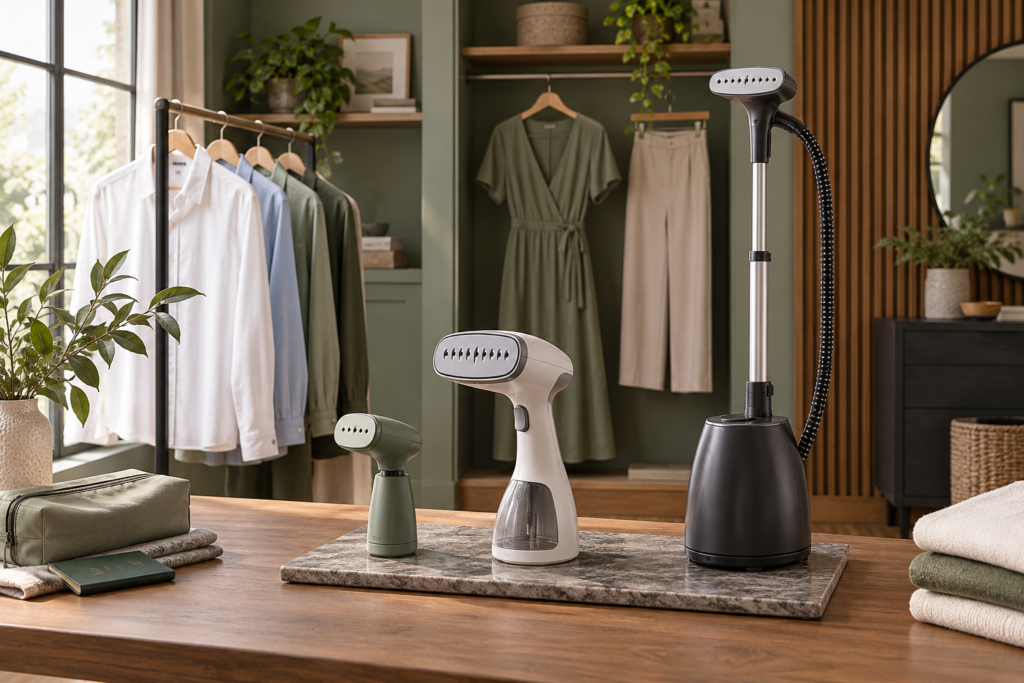
Choose by the job, not a ranking alone
There is no universal best clothes steamer. Compact handhelds, powerful handhelds and full-size uprights make different compromises. This refresh replaces vague or unavailable recommendations with exact current model numbers confirmed on manufacturer sites in October 2026.
The current shortlist covers travel, everyday handheld use, one-handed finishing, frequent upright sessions and repairable professional-style construction. Published numbers are useful for narrowing the field, but they do not guarantee comfort or results on every fabric.
| Current model | Exact number | Best fit |
|---|---|---|
| Rowenta Pure Pop | DR2024U1 | Fast touch-ups and light travel |
| Conair Turbo ExtremeSteam Steam & Press | GS38R | Heavier everyday fabrics and users who want a heated pressing surface |
| BLACK+DECKER Advanced Handheld Steamer | HGS200 | Everyday home use with fabric-specific attachments |
| Rowenta Pro Style Care Upright Steamer | IS8440U1 | Frequent home use and a supported vertical work surface |
| Jiffy Clothing Steamer | J-2000 | Repairability, long sessions and simple professional-style construction |
Rowenta Pure Pop is an 1150-watt, 1.57-pound handheld with a 15-second heat-up, 20 g/min output and a 2.4-ounce removable tank. Those facts come from the current manufacturer page.
Rowenta Pure Pop
It is the strongest fit for fast touch-ups and light travel.
Conair Turbo ExtremeSteam Steam & Press is a 7.3-ounce-tank handheld with regular and turbo steam, a 40-second heat-up, built-in creaser and three-part attachment. Those facts come from the current manufacturer page.
Conair Turbo ExtremeSteam Steam & Press
It is the strongest fit for heavier everyday fabrics and users who want a heated pressing surface.
BLACK+DECKER Advanced Handheld Steamer is a 1400-watt handheld with continuous and burst controls, three attachments and automatic shutoff after inactivity. It is the strongest fit for everyday home use with fabric-specific attachments. Those facts come from the current manufacturer page.
BLACK+DECKER Advanced Handheld Steamer
A handheld option when you want a dedicated steamer for everyday garment touch-ups at home.
Rowenta Pro Style Care Upright Steamer is a current 1700-watt upright with 35 g/min continuous steam, four settings, 45-second heat-up, 44-ounce removable tank and vertical support. Those facts come from the current manufacturer page.
Rowenta Pro Style Care Upright Steamer
It is the strongest fit for frequent home use and a supported vertical work surface.
Jiffy Clothing Steamer is a current home/light-commercial upright assembled in Tennessee with a 3/4-gallon reservoir, rolling base, replaceable parts and a three-year manufacturer warranty. Those facts come from the current manufacturer page.
Jiffy Clothing Steamer
It is the strongest fit for repairability, long sessions and simple professional-style construction.
How to make the final choice
List the garments you handle most often and the number normally treated in one session. A small tank can be reasonable for one shirt before work and frustrating for a week of travel clothes. A tall upright can be efficient for a household wardrobe and inconvenient in a small apartment. Measure storage space and consider the complete setup, including hanger, board, hose, attachments and cord.
Ignore prices captured in old articles. Availability, seller and grouped variants change. Keep the exact model number with the manual and order record. If replacement tanks, brushes or other wear parts matter, confirm that support before purchase.
Use a repeatable test before deciding
Test a new appliance while the return window is open. Fill it according to the manual, allow it to reach its ready state, and steam the same clean cotton shirt or pillowcase with each setting you plan to use. Note the real heat-up time, whether the handle becomes tiring, how easily the tank refills, and whether the head spits when it changes direction. A familiar item makes comparison more useful than a dramatic demonstration on an unknown fabric.
Then repeat the test on one garment that represents your normal routine. Check the care label, begin at the lowest suitable setting, and test a hidden area. A specification cannot reveal balance, button placement, cord drag or how confidently you can keep the steam away from your free hand. Those practical details often determine whether an appliance is used weekly or left in a closet.
Use heat and steam with care
Read the current manual before the first use because models differ in water type, operating angle, contact with fabric and descaling method. Never steam clothing while it is being worn, direct steam toward skin, or leave a plugged-in appliance unattended. Keep the cord away from walkways and water, and place the appliance only on the stable surface described by its maker.
The garment label remains the authority for the textile. Test an inside seam before treating silk, rayon, velvet, coated fabric, prints or glued decoration. Steam can relax ordinary wrinkles, but it does not replace laundering or professional cleaning. Let garments cool and dry before storage, empty the reservoir if instructed, and allow the appliance to cool fully before putting it away.
Record what works
A short garment-care note can save time later. Record the fabric, setting, working distance and number of passes that produced a good result. Photograph an unusual care label and keep the model manual with the appliance. If several people share the tool, this simple record reduces guesswork and discourages someone from copying a hotter setting onto a more sensitive garment.
Recheck the routine when the season, water supply or garment construction changes. A method that works on an unlined cotton shirt may be wrong for a lined dress or coated textile. Consistent results come from observing the fabric rather than forcing every item through the same process.