
Reviewed and updated: October 18, 2026
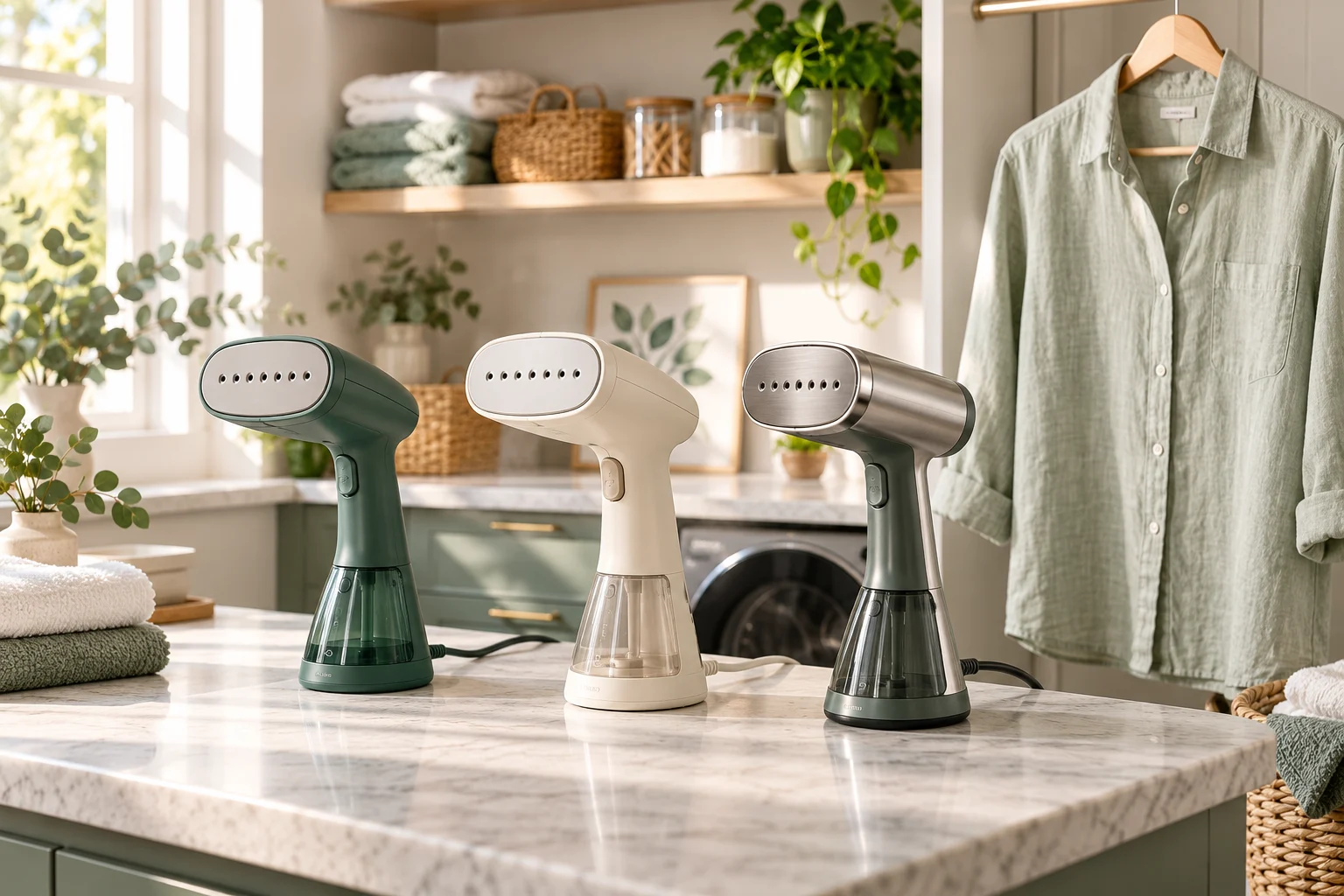
A handheld steamer should match your fabrics, session length, grip, water routine, and storage. Compare the exact model's settings and care instructions before chasing maximum wattage.
This guide was reviewed against current official product information where a model is discussed. Specifications and packages can change, so verify the exact label or manufacturer page before acting.
Start with fabric and session length
List what you actually steam: one work shirt, a travel outfit, delicate blouses, heavy curtains, or several garments at once. A compact tank suits quick touch-ups but interrupts longer sessions. Higher steam output can help durable fabric yet increases heat, weight, and water use. No steamer is safe for every material. Read the garment care label and the appliance manual, then test an inconspicuous area with the lowest suitable setting before treating the visible surface.
Use current model numbers
Conair currently lists the GS59X Steam & Press with Turbo with five steam settings, a heated aluminum plate, a built-in creaser, a 3-in-1 attachment, a stated 40-second heat-up, and up to 20 minutes of steam. Its documentation covers GS59-family safety and technique. GS108 is a different ExtremeSteam model with different attachments and instructions. Treat the letters and numbers as essential. Marketplace listings may combine generations, colors, or refurbished units under one review page.
Compare steam settings, not just wattage
Wattage describes electrical input, not how safely or evenly a steamer works on a particular fabric. Multiple settings can help move from delicate to durable materials, but only when the manual explains their use. A metal plate can press and smooth, yet it also creates direct heat and must not rest on fabric. Start low, keep the head moving, and increase only when the fabric and instructions support it. Never chase a wrinkle by holding steam in one place.
Check tank design and water guidance
A removable tank is easier to fill without wetting the appliance, while an integrated tank can reduce seams. Confirm capacity, fill line, orientation, and the exact water recommendation. Distilled-water advice varies with model and local water, so follow the manufacturer rather than a universal rule. Never add fragrance, starch, vinegar, or cleaning solution unless the manual explicitly allows it. Empty and dry the tank as directed, and keep electrical parts away from sinks and dripping garments.
Judge grip, balance, and cord path
A steamer that feels manageable when empty can become tiring when full. Compare handle diameter, trigger behavior, center of gravity, and whether steam can be locked on. Plan where the cord will run so it does not cross a wet counter, doorway, or walking path. A longer cord adds reach but also needs safe management. If hand strength or mobility is limited, test the loaded weight before the return window closes. Comfort improves control and reduces accidental contact.
Understand plates and attachments
A fabric spacer can limit direct plate contact, a brush can help steam reach durable fibers, and a creaser can form an edge. Attachments are model-specific and remain hot after use. Install or remove them only as directed, usually after unplugging and cooling. Do not assume an attachment turns an unsafe fabric into a safe one. Embellishments, coatings, adhesives, prints, leather, suede, and structured garments may require professional care or a different method.
Plan storage and maintenance
Let the unit cool upright on a heat-safe surface. Unplug it, release remaining pressure as instructed, empty the tank when required, and allow components to dry. Do not wrap the cord tightly around a hot appliance. Mineral buildup can reduce performance, but descaling methods are model-specific. Use only the procedure in the manual. Replace a cracked tank, damaged cord, loose plug, leaking body, or erratic control rather than trying to seal or tape an appliance that combines water and electricity.
Choose the simplest suitable model
Choose GS59X when its settings, heated plate, creaser, and session length fit your garments and you accept the larger handheld format. Compare GS108 when its shape and accessory set suit you better. Use a smaller travel steamer only when its voltage, tank, output, and safety instructions match the trip. Verify official specifications first, then use the affiliate searches to locate the exact model. Avoid listings that substitute a similar body or hide the model number.
Quick checklist
- List fabrics and normal session length.
- Match the exact model and manual.
- Begin with the lowest suitable setting.
- Confirm water and tank instructions.
- Test loaded grip and cord placement.
- Cool, empty, clean, and store as directed.
Why these checkpoints matter
- List fabrics and normal session length. This defines the starting condition and prevents the rest of the process from resting on an assumption.
- Match the exact model and manual. This narrows the choice to evidence you can verify on the exact label, model, or scene.
- Begin with the lowest suitable setting. This checkpoint reduces avoidable risk before another variable is introduced.
- Confirm water and tank instructions. This keeps the routine compatible with the person, product, material, or equipment involved.
- Test loaded grip and cord placement. This creates a repeatable step instead of relying on memory or marketing language.
- Cool, empty, clean, and store as directed. This final review catches changes in condition, availability, or instructions before the next use.
Common questions
Is more wattage always better?
No. Settings, steam delivery, plate design, fabric compatibility, ergonomics, and care matter more than one number.
Can I add fragrance to the tank?
Only if the exact manual permits it. Most steamers should receive only the specified water.
Can a handheld steamer replace an iron?
It can handle many wrinkles, but crisp seams, heavy fabric, and structured garments may still need pressing or professional care.
Official product references
Compare current Amazon listings
Conair Turbo ExtremeSteam GS59X
Confirm the exact product, model or size, package contents, seller, current price, and availability.
Check current Amazon listings (paid link)(paid link)
Conair ExtremeSteam GS108
Confirm the exact product, model or size, package contents, seller, current price, and availability.
Check current Amazon listings (paid link)(paid link)
handheld garment steamer with multiple steam settings
Confirm the exact product, model or size, package contents, seller, current price, and availability.
Check current Amazon listings (paid link)(paid link)
Keep the decision useful
Write down the exact model, label, starting condition, and result. Change one variable at a time and return to the official instructions when anything is unclear. A short record makes the next decision easier and keeps an isolated result from becoming a rule that does not fit a different product, person, material, or environment.
Review the information again before repeating the process. Stop when comfort, safety, condition, or the manufacturer’s instructions provide a reason to stop. A useful routine stays simple because every step answers a real question.