Brabantia Sleeve Board Review: Do You Need a Narrow Ironing Surface?
Decide whether a narrow folding board fits your shirts, work area, and preferred sleeve finish.
Reviewed and updated November 4, 2026 · By Wrinkle Free Steamer
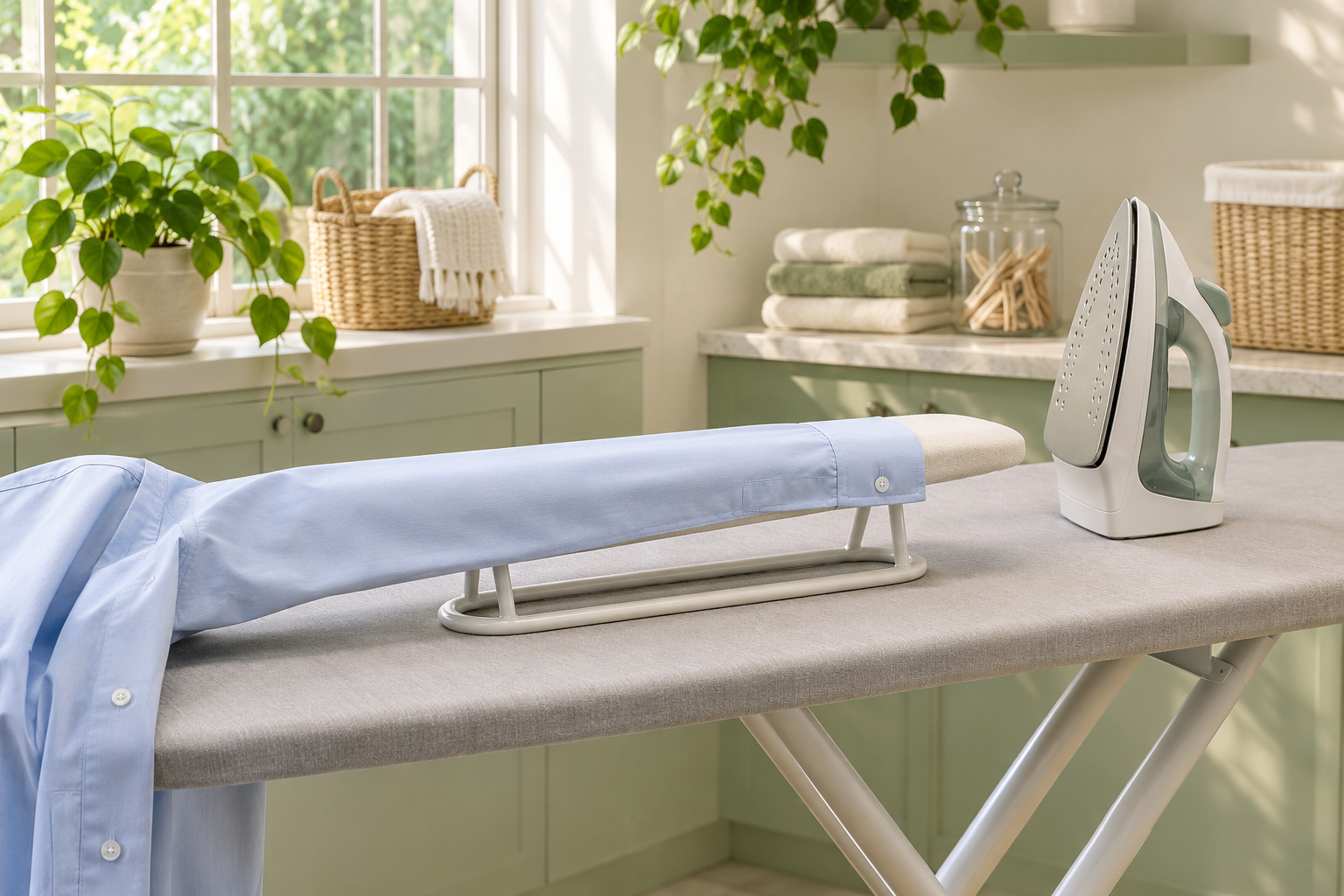
A sleeve board is worth considering when shirts look tidy across the chest but awkward folds remain down the arms. Its narrow surface lets you work on one side of a sleeve without flattening both layers together. The Brabantia 60 x 10 cm Sleeve Board is a focused accessory for that job. Buy it for access around small garment sections, rather than as a replacement for your main ironing board.
This review evaluates documented features and how the format fits a home pressing routine; it does not report hands-on testing. The strongest reason to choose it is a wardrobe with frequently pressed sleeves and a place to set up a second support. If your usual finish is relaxed, steam-softened clothing, you may get little value from adding another board.
What the Brabantia board includes
Brabantia identifies the Ecru version as SKU 102400, with a 60 x 10 cm pressing surface. Its current specifications describe a cotton cover over a 5 mm foam layer, protective non-slip caps, an elastic-cord cover fit, and a folding frame with a hanging loop. The manufacturer lists compatibility with regular and steam irons. These are design specifications, rather than a promise about results on a particular shirt.
Brabantia Sleeve Board, 60 x 10 cm, Ecru
Choose this narrow folding support for sleeves you want to press without a deliberate full-length crease. Use a full-size board for shirt fronts, bed linen and long trouser panels.
Check sleeve fit before ordering
Measure a representative shirt at its narrowest section, especially around the cuff opening. A sleeve must slide over the support without stretching the fabric or forcing a seam. The nominal surface width alone does not establish clearance: the padded thickness, sleeve taper, cuff construction, and frame beneath it all matter. Very small children’s sleeves and unusually narrow tailoring deserve particular attention.
Think about the end you will need to reach. A shirt cuff that opens fully gives different access from a closed tube or a jacket sleeve with a lining. If you cannot slide the intended section onto a board comfortably, a smaller sewing aid or professional finishing may suit that garment better. Do not assume every sleeve will fit because the accessory is called a sleeve board.
Who should choose it
Consider this board if you routinely iron woven shirts and prefer rounded sleeves without a sharp side crease. It also makes sense when small sections are difficult to isolate on a broad board. A narrow support can help position the area you want to press while leaving surrounding fabric out of the way. The practical benefit is access, not increased iron power.
It is most useful when the main board already works well. You keep the large surface for shirt backs and fronts, then bring out the sleeve board for confined areas. That division suits someone willing to reposition a garment carefully. If you already enjoy sewing or detailed garment care, the extra setup may feel reasonable; for a rushed single-shirt routine, it may feel cumbersome.
When is a different option useful?
A loose main board, worn cover or leaking iron needs attention before adding a sleeve board. A sleeve accessory does not resolve those faults. Likewise, it adds little if you deliberately press a crease into shirt sleeves by laying both layers flat. Your present board already provides the broad, flat surface needed for that finish.
For loose casual tops that only need wrinkles relaxed, a garment steamer may fit the routine better. Our steamer versus iron guide explains that choice. Structured jackets, delicate linings, and uncertain care labels are reasons to seek garment-specific advice, rather than buying a tool and experimenting with hotter settings.
Compare the format with simpler alternatives
A full-size board is the first choice for large flat sections. It offers room to spread a garment and see whether layers are aligned. The disadvantage for a sleeve is that pressing the flattened tube can leave an edge crease. That crease may be desirable, so decide on the intended finish before treating it as a problem requiring another purchase.
A rolled towel can provide temporary support for gentle shaping, but its thickness and surface are less consistent than a purpose-made board. Keep colored, textured, or contaminated towels away from pressing work. A tailor’s ham serves curved shaping tasks and is a different tool; it does not offer a long narrow surface for an entire sleeve. Buy for the section you repeatedly struggle to support.
Allow space for the complete setup
Plan where the accessory will stand and where the iron will rest while you move the shirt. A folding design helps with storage, but the equipment still needs a stable working location. Keep the board fully supported and the cord clear of its frame. Non-slip caps are useful features, yet they do not make a cluttered or uneven work surface suitable.
Leave room for the garment to drape without catching on a drawer handle or touching the floor. Keep the sleeve board separate from the iron’s approved rest. Before putting equipment away, allow the iron and fabric to cool and ensure the cover is dry. The hanging loop may suit a utility cupboard, provided stored items cannot fall against the hot appliance.
Protect the garment and the cover
Read the garment label before deciding whether to iron at all. A cotton board cover does not permit a higher temperature on the clothing. Start with the setting allowed for the garment, test a hidden section, and avoid pressing over plastic decorations or uncertain adhesives. Our care-label guide is a useful starting point for interpreting restrictions.
A pressing cloth addresses direct contact with the soleplate; it does not replace adequate support underneath. If you need that barrier, our pressing-cloth comparison explains the separate decision. Keep any cloth smooth and clean. Lift and reposition the iron instead of dragging a sleeve against the frame, and check the result after cooling before adding more heat.
The purchase decision
Choose the Brabantia 102400 when narrow access is a recurring need, your sleeves can fit over the support, and you have room to use it safely alongside a main board. Its folding construction and fitted padded cover make it a practical format to investigate for a dedicated pressing station.
A full-size board provides more pressing space. A leaking iron needs its own repair. Start with one awkward shirt and identify the exact section you cannot support well. If a narrow board solves that repeatable problem, this is a purposeful accessory. If not, keeping your current setup and refining garment placement is the more sensible choice.