How to Steam Wool Safely Without Shine or Stretch
Practical guidance for caring for your clothes and equipment.
Reviewed and updated October 30, 2026
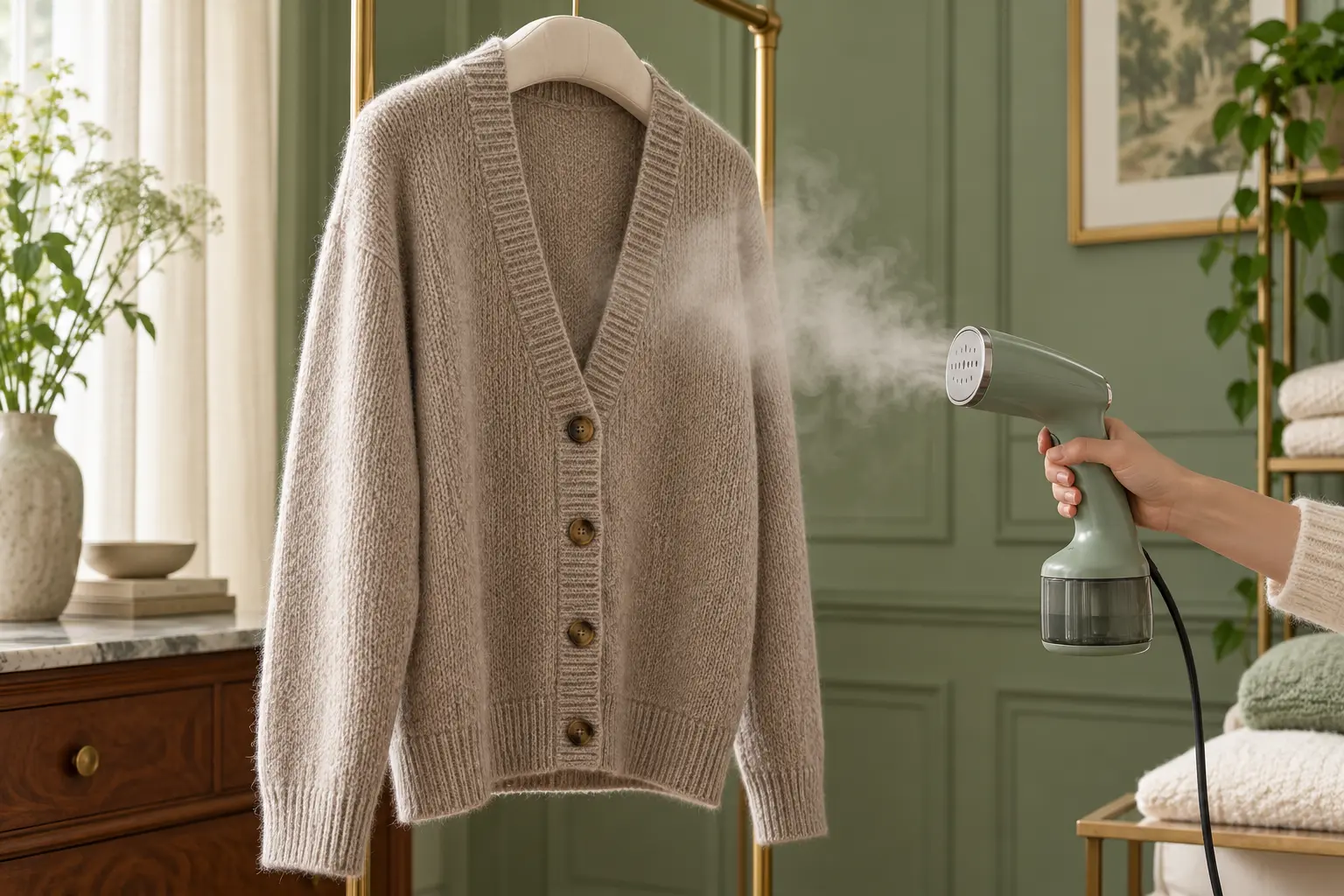
Wool responds to moisture, heat, pressure, and gravity. Gentle steam can relax wrinkles, but the care label and garment construction decide whether home steaming is appropriate.
This guide was reviewed against current official product information where a model is discussed. Specifications and packages can change, so verify the exact label or manufacturer page before acting.
Start with the care label
Read the fiber content, lining, trim, and care symbols before heating the steamer. A wool blend may include acetate, viscose, elastane, adhesives, or structured interfacing with different limits. If the label says dry clean only or warns against steam, follow it. Valuable tailoring deserves professional advice rather than a hidden experiment.
Support the garment correctly
Use a broad padded hanger for a jacket or cardigan so wet weight does not create shoulder points. Heavy knits are often safer laid flat on a clean towel and reshaped gently. Empty pockets, fasten the garment as directed, and support collars or hems with a heat-resistant mitt kept behind the fabric, never in the steam path.
Test a hidden area first
Choose an inside seam or concealed allowance and apply the minimum steam exposure from the recommended distance. Let it cool and dry before judging color, texture, shine, distortion, or water spotting. A quick wet look can disappear, but permanent flattening or dye movement may become clearer only after drying.
Keep the steamer moving
Use smooth downward passes without pressing the hot plate into wool unless the appliance and garment instructions explicitly permit contact. Hold the fabric lightly rather than pulling it taut. Pause between passes so fibers can relax. Concentrated steam in one area can saturate the cloth, soften structure, or create a stretched patch.
Protect the nap and finish
Velvet-like wool, brushed coatings, and dark suiting can show marks when rubbed or compressed. Steam from the reverse where appropriate and avoid scraping with attachments. Do not chase a crease by pressing harder. For trousers or tailored lapels, a professional press may preserve shape better than freehand vertical steaming.
Manage seams, linings, and details
Buttons, shoulder pads, fusible interfacing, leather trim, and decorative finishes may react differently from the wool shell. Work around them rather than flooding the whole area. Support a lined hem so the outer and inner fabrics do not dry at different lengths. Stop if bubbling, puckering, dye transfer, or odor appears.
Let wool cool in shape
After steaming, leave the garment supported with space around it until completely cool and dry. Do not put it on, fold it, or crowd it in a closet while warm and damp. For a knit laid flat, return edges, cuffs, and hem to their natural dimensions without stretching. Brush only when the fabric instructions allow it.
Know when to use a professional
Choose professional care for structured suits, heirloom pieces, unknown stains, strong odors, moth damage, water marks, or any garment whose construction is unclear. Steam can set some stains or spread residue. A cleaner or tailor can identify when controlled pressing, blocking, stain treatment, or repair should come first.
Quick checklist
- Read every fiber and care instruction.
- Support wool without pulling.
- Test and let the spot dry.
- Use moving, non-contact passes.
- Protect nap, lining, and structure.
- Cool and dry fully in shape.
Why these checkpoints matter
- Read every fiber and care instruction. This defines the starting condition and prevents the rest of the process from resting on an assumption.
- Support wool without pulling. This narrows the choice to evidence you can verify on the exact label, model, or scene.
- Test and let the spot dry. This checkpoint reduces avoidable risk before another variable is introduced.
- Use moving, non-contact passes. This keeps the routine compatible with the person, product, material, or equipment involved.
- Protect nap, lining, and structure. This creates a repeatable step instead of relying on memory or marketing language.
- Cool and dry fully in shape. This final review catches changes in condition, availability, or instructions before the next use.
Common questions
Can I steam a wool suit at home?
Only when the care label and construction permit it; structured tailoring is often safer with professional care.
Why did wool look shiny after steaming?
Heat, pressure, or rubbing may have flattened the surface. Stop and seek professional help rather than adding more steam.
Should a wool sweater hang while steaming?
Heavy knits may stretch when damp, so flat steaming and flat drying can be safer.
Keep the decision useful
Write down the exact model, label, starting condition, and result. Change one variable at a time and return to the official instructions when anything is unclear. A short record makes the next decision easier and keeps an isolated result from becoming a rule that does not fit a different product, person, material, or environment.
Review the information again before repeating the process. Stop when comfort, safety, condition, or the manufacturer’s instructions provide a reason to stop. A useful routine stays simple because every step answers a real question.
For the next attempt, note what improved, what remained uncertain, and what should stay unchanged. This final check reduces guesswork and helps small problems become visible before they turn into repeated mistakes.
Keep the original instructions, model information, and observations together. Before repeating the process, confirm that the product, setting, environment, and intended result are still the same.
Use the result as one observation rather than a promise. Conditions change, and the safest next step is the one supported by the current label, manual, evidence, and the limits you can verify.
Use the result as one observation rather than a promise. Conditions change, and the safest next step is the one supported by the current label, manual, evidence, and the limits you can verify.
Use the result as one observation rather than a promise. Conditions change, and the safest next step is the one supported by the current label, manual, evidence, and the limits you can verify.
Use the result as one observation rather than a promise. Conditions change, and the safest next step is the one supported by the current label, manual, evidence, and the limits you can verify.
Use the result as one observation rather than a promise. Conditions change, and the safest next step is the one supported by the current label, manual, evidence, and the limits you can verify.
Use the result as one observation rather than a promise. Conditions change, and the safest next step is the one supported by the current label, manual, evidence, and the limits you can verify.
Use the result as one observation rather than a promise. Conditions change, and the safest next step is the one supported by the current label, manual, evidence, and the limits you can verify.