Best Full-Size Garment Steamers for Home Use
Compare practical features, fit and everyday use.
Reviewed and updated October 30, 2026
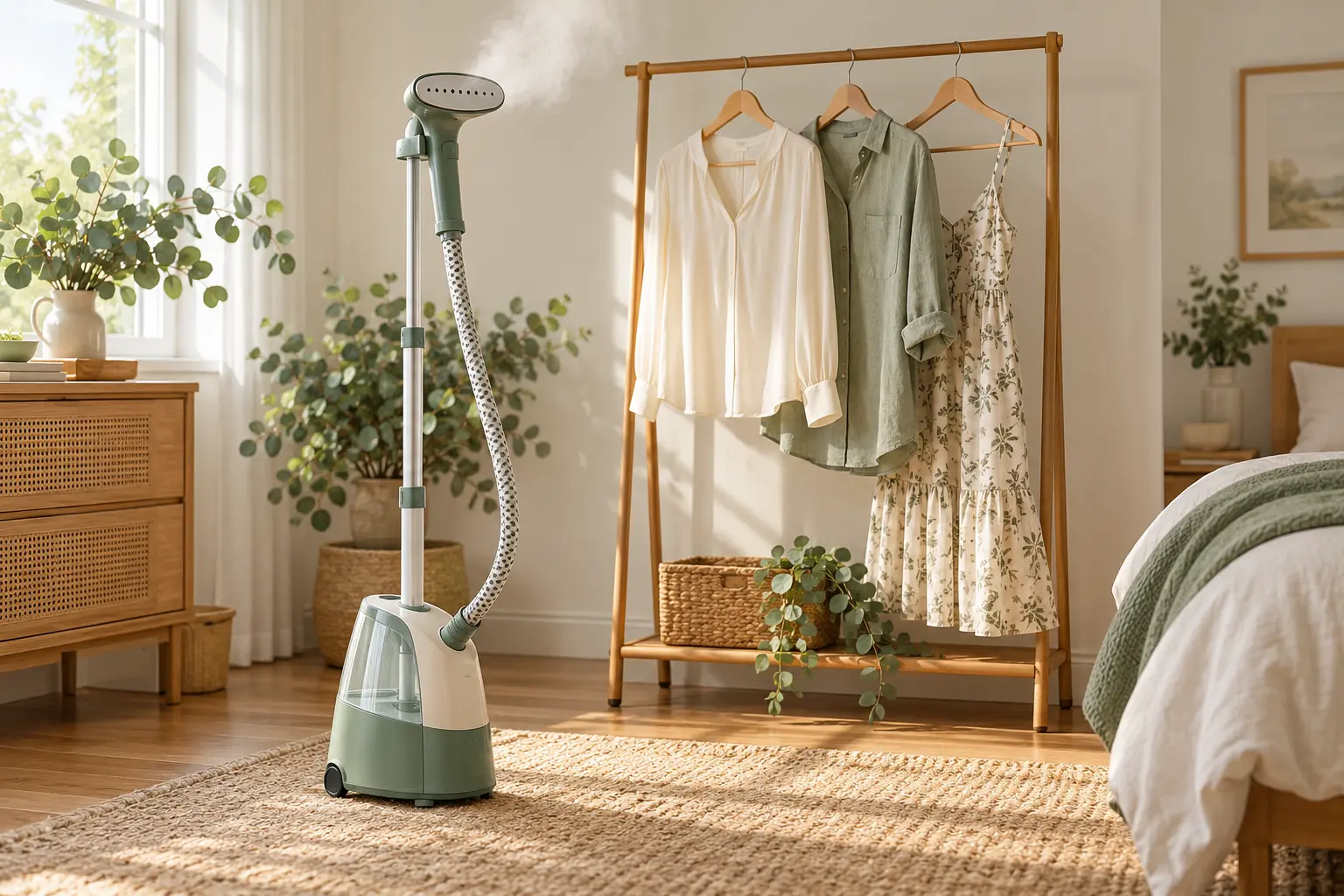
A full-size steamer earns its floor space through steady steam, a manageable hose, stable base, usable tank, and serviceable parts. Compare the exact routine rather than wattage alone.
This guide was reviewed against current official product information where a model is discussed. Specifications and packages can change, so verify the exact label or manufacturer page before acting.
Decide whether full size is justified
An upright steamer suits repeated shirts, dresses, linens, or household batches when storage space is available. Occasional one-garment touchups may be easier with a handheld model. Measure the planned storage spot, outlet distance, ceiling clearance, and rolling path before buying a tall appliance with a hose and water tank.
Compare current reference models
Jiffy currently lists the J-2000 home clothing steamer with a large water caddy and several head options. Rowenta’s upright Pro Style family emphasizes an integrated support and vertical setup, while Conair offers full-size upright models in its garment-care line. Exact model names and packages change, so verify every listing.
Look beyond heat-up time
Fast startup is convenient, but continuous steam behavior, tank access, refill rules, and cooldown affect the whole session. Check whether the model can be refilled while operating, how long the hose takes to clear condensation, and what automatic protection it includes. Never infer safety features from a similar model.
Examine the head and hose
A metal faceplate can add pressing contact when the fabric allows it; a plastic head may feel lighter. Hose length, flexibility, insulation, and hanger height determine reach. The hose should remain upright enough for condensation to return as directed. Kinks and low loops can cause sputtering and hot droplets.
Match attachments to real garments
A fabric brush, crease tool, bonnet, board, or pants clip is useful only when compatible with the fabric and easy to store. Confirm which accessories are included rather than shown as optional. Read the care label before applying steam, test an inconspicuous area, and keep hands away from the steam path.
Plan water, cleaning, and service
Follow the exact water recommendation and descaling method. Compare tank opening, drain access, replaceable parts, warranty, and service availability. Jiffy highlights replacement parts and repair support; other brands may use different systems. A lower purchase price can be less attractive if a small damaged component cannot be replaced.
Check stability and household safety
A wide stable base, locking or smooth casters, cord storage, and a secure pole matter around children, pets, and narrow rooms. Keep the machine on a level heat-safe floor and route the cord away from traffic. Never leave a hot steamer unattended or move it by pulling the hose.
Choose for the workload
Choose Jiffy J-2000 when repairable construction and long sessions matter, a current Rowenta upright when integrated garment support fits the routine, or a current Conair full-size model when familiar controls and broad availability are priorities. Verify official details first, then compare exact paid listings. Availability remains API-unverified.
Quick checklist
- Measure storage and working space.
- Compare tank and refill routine.
- Check hose, head, and condensation guidance.
- Verify included attachments.
- Review cleaning and replacement parts.
- Prioritize a stable base and safe cord path.
Why these checkpoints matter
- Measure storage and working space. This defines the starting condition and prevents the rest of the process from resting on an assumption.
- Compare tank and refill routine. This narrows the choice to evidence you can verify on the exact label, model, or scene.
- Check hose, head, and condensation guidance. This checkpoint reduces avoidable risk before another variable is introduced.
- Verify included attachments. This keeps the routine compatible with the person, product, material, or equipment involved.
- Review cleaning and replacement parts. This creates a repeatable step instead of relying on memory or marketing language.
- Prioritize a stable base and safe cord path. This final review catches changes in condition, availability, or instructions before the next use.
Common questions
Is a full-size steamer better than a handheld?
It can be better for repeated batches, but a handheld may suit limited space and occasional use.
Can I refill while it is hot?
Only when the exact manual explicitly allows that method.
Does more wattage guarantee better results?
No. Steam delivery, head design, fabric compatibility, and handling all matter.
Compare current Amazon listings
Jiffy J-2000 garment steamer
Confirm the exact product, model or size, package contents, seller, current price, and availability.
Rowenta upright garment steamer
Confirm the exact product, model or size, package contents, seller, current price, and availability.
Conair full-size garment steamer
Confirm the exact product, model or size, package contents, seller, current price, and availability.
Keep the decision useful
Write down the exact model, label, starting condition, and result. Change one variable at a time and return to the official instructions when anything is unclear. A short record makes the next decision easier and keeps an isolated result from becoming a rule that does not fit a different product, person, material, or environment.
Review the information again before repeating the process. Stop when comfort, safety, condition, or the manufacturer’s instructions provide a reason to stop. A useful routine stays simple because every step answers a real question.
For the next attempt, note what improved, what remained uncertain, and what should stay unchanged. This final check reduces guesswork and helps small problems become visible before they turn into repeated mistakes.
Keep the original instructions, model information, and observations together. Before repeating the process, confirm that the product, setting, environment, and intended result are still the same.
Use the result as one observation rather than a promise. Conditions change, and the safest next step is the one supported by the current label, manual, evidence, and the limits you can verify.
Use the result as one observation rather than a promise. Conditions change, and the safest next step is the one supported by the current label, manual, evidence, and the limits you can verify.
Use the result as one observation rather than a promise. Conditions change, and the safest next step is the one supported by the current label, manual, evidence, and the limits you can verify.
Use the result as one observation rather than a promise. Conditions change, and the safest next step is the one supported by the current label, manual, evidence, and the limits you can verify.