How to Choose a Garment Steamer: A Practical Guide (Updated 2026)
Compare practical features, fit and everyday use.
Reviewed and updated October 8, 2026
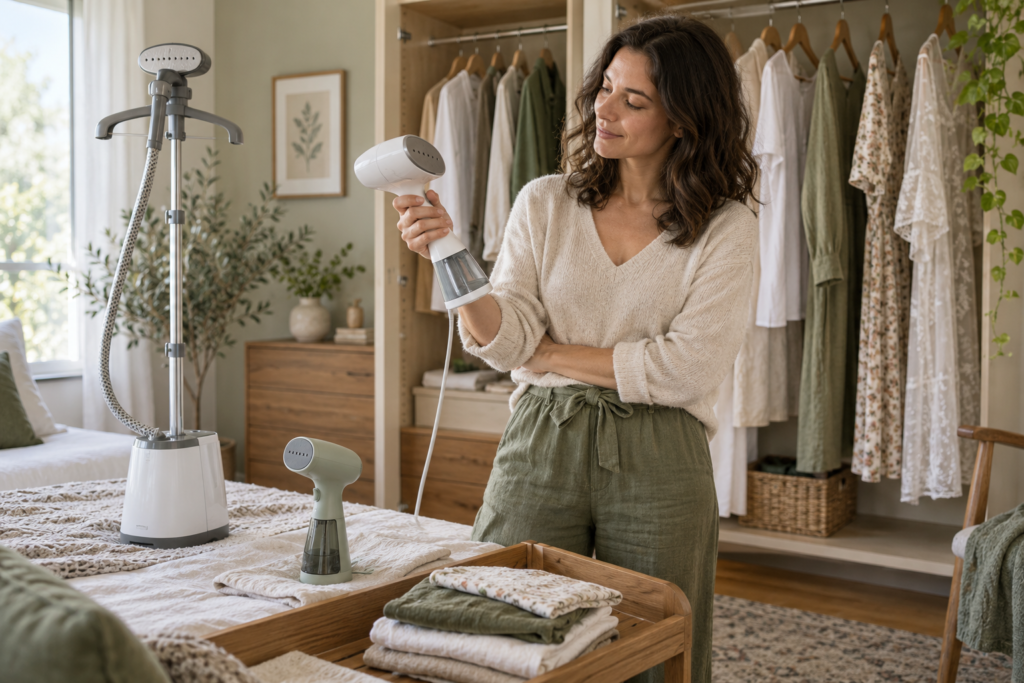
Choose by the job, not a ranking alone
A good garment steamer fits the work, storage space and electrical setting rather than winning one specification contest. This refresh replaces vague or unavailable recommendations with exact current model numbers confirmed on manufacturer sites in October 2026.
Start with format, then compare model number, tank design, heat-up time, settings, cord or hose reach, auto-off behavior and parts support. Published numbers are useful for narrowing the field, but they do not guarantee comfort or results on every fabric.
| Current model | Exact number | Best fit |
|---|---|---|
| Conair Power Steam Worldwide Travel Garment Steamer | GSC24BL | International travel and compact packing |
| BLACK+DECKER Advanced Handheld Steamer | HGS200 | Everyday home use with fabric-specific attachments |
| Rowenta Pro Style Care Upright Steamer | IS8440U1 | Frequent home use and a supported vertical work surface |
Conair Power Steam Worldwide Travel Garment Steamer is a dual-voltage 1200-watt travel design with a 35-second heat-up, adjustable head and removable tank. It is the strongest fit for international travel and compact packing. Those facts come from the current manufacturer page.
Conair Power Steam Worldwide Travel Garment Steamer
Selectable dual voltage, an adjustable head and a collapsible hanger make this our choice for travel between voltage systems.
BLACK+DECKER Advanced Handheld Steamer is a 1400-watt handheld with continuous and burst controls, three attachments and automatic shutoff after inactivity. It is the strongest fit for everyday home use with fabric-specific attachments. Those facts come from the current manufacturer page.
BLACK+DECKER Advanced Handheld Steamer
A handheld option when you want a dedicated steamer for everyday garment touch-ups at home.
Rowenta Pro Style Care Upright Steamer is a current 1700-watt upright with 35 g/min continuous steam, four settings, 45-second heat-up, 44-ounce removable tank and vertical support. Those facts come from the current manufacturer page.
Rowenta Pro Style Care Upright Steamer
It is the strongest fit for frequent home use and a supported vertical work surface.
How to make the final choice
List the garments you handle most often and the number normally treated in one session. A small tank can be reasonable for one shirt before work and frustrating for a week of travel clothes. A tall upright can be efficient for a household wardrobe and inconvenient in a small apartment. Measure storage space and consider the complete setup, including hanger, board, hose, attachments and cord.
Ignore prices captured in old articles. Availability, seller and grouped variants change. Keep the exact model number with the manual and order record. If replacement tanks, brushes or other wear parts matter, confirm that support before purchase.
Use a repeatable test before deciding
Test a new appliance while the return window is open. Fill it according to the manual, allow it to reach its ready state, and steam the same clean cotton shirt or pillowcase with each setting you plan to use. Note the real heat-up time, whether the handle becomes tiring, how easily the tank refills, and whether the head spits when it changes direction. A familiar item makes comparison more useful than a dramatic demonstration on an unknown fabric.
Then repeat the test on one garment that represents your normal routine. Check the care label, begin at the lowest suitable setting, and test a hidden area. A specification cannot reveal balance, button placement, cord drag or how confidently you can keep the steam away from your free hand. Those practical details often determine whether an appliance is used weekly or left in a closet.
Use heat and steam with care
Read the current manual before the first use because models differ in water type, operating angle, contact with fabric and descaling method. Never steam clothing while it is being worn, direct steam toward skin, or leave a plugged-in appliance unattended. Keep the cord away from walkways and water, and place the appliance only on the stable surface described by its maker.
The garment label remains the authority for the textile. Test an inside seam before treating silk, rayon, velvet, coated fabric, prints or glued decoration. Steam can relax ordinary wrinkles, but it does not replace laundering or professional cleaning. Let garments cool and dry before storage, empty the reservoir if instructed, and allow the appliance to cool fully before putting it away.
Record what works
A short garment-care note can save time later. Record the fabric, setting, working distance and number of passes that produced a good result. Photograph an unusual care label and keep the model manual with the appliance. If several people share the tool, this simple record reduces guesswork and discourages someone from copying a hotter setting onto a more sensitive garment.
Recheck the routine when the season, water supply or garment construction changes. A method that works on an unlined cotton shirt may be wrong for a lined dress or coated textile. Consistent results come from observing the fabric rather than forcing every item through the same process.
Plan for storage and maintenance
Let the appliance cool completely before emptying or storing it, and follow the manual rather than forcing open a warm tank. Keep the cord loosely arranged, protect a hose from sharp bends and store attachments with the model they fit. A dry, easy-to-reach storage place makes routine use more likely and helps reveal a leak or damaged part before the next session.
Set a calendar reminder for the cleaning interval recommended by the maker. Hard-water deposits, lint and residue can change steam flow over time, while aggressive homemade cleaners can damage seals or internal coatings. Use only the maintenance method approved for the exact model and replace an appliance when electrical damage or unsafe leaking cannot be corrected through documented service.
Use a pre-purchase checklist
Before buying or replacing a garment-care appliance, write down where it will be used, which fabrics appear most often, how many garments make up a normal session and where the hot appliance will cool. The exact model number identifies the appliance and the instructions that apply. Check voltage, tank size, approved water type, operating position, included attachments, warranty contact and return window. If a feature is essential, verify it in the current manual instead of assuming that a similar photo means the same specification.
Also consider the full routine around the appliance. A larger tank may reduce refills but take more storage space. A light handheld can be convenient for one garment while feeling slow across several outfits. An upright system may support longer sessions but needs a stable footprint and room for its hose. The best choice is the one that fits the actual wardrobe, work area and maintenance habits, with documentation that remains available after purchase.